Locking Down Your Security Online

For a long time, online security was treated as something peripheral… a background concern handled by specialists. Software, connections, default settings – most of us assumed that that was someone else’s responsibility. Making sure that all the internet tools and systems were all set up and working safely – that was usually only ever thought about after something had gone horribly wrong.
Well, that assumption can no longer hold up to the cold light of the modern day office environment. Using the internet without deliberately locking down your security must now be considered a risk most individuals and businesses simply cannot afford to take. Online security is no longer passive or optional. It requires active responsibility over how safely, confidently and securely we operate online.
It is no longer an IT problem. It is a business skill, and like any skill that directly affects income, reputation and peace of mind, it deserves conscious and professional attention.
If you run a business, manage digital assets, consult with clients, or earn your living online in any other professional capacity, it is no longer a question of whether security matters. It is a question of whether you are operating with an appropriate understanding of risk, or leaving parts of your online world exposed because of habits formed in a very different internet era from the one we are working in today.
Most people reading this are not reckless online. You probably use strong passwords, avoid obvious phishing attempts, enable two-factor authentication and keep your devices reasonably clean. Until recently, that was enough. You are now working across more tools, networks and locations than before. So, it is no longer enough to flippantly take no heed of these things. This is not because you have become careless, but because the way you work has changed.
Consider how people like us work in this modern world:
- cloud-based tools
- multiple SaaS logins
- client dashboards
- ad platforms
- analytics accounts
- payment processors
- email as a command centre
- remote work as default
- public or semi-public Wi-Fi as normal
Your professional life is no longer confined to a secure office network. It is distributed across cafés, hotels, airports, co-working spaces and home routers of varying quality.
Perhaps it is worth pausing for a moment, if only to recognise just how much your work environment has changed in the last few years alone.
Most security failures these days do not happen because someone was careless or uninformed. They mostly happen because someone was doing what now counts as ‘normal’.
Normal working behaviour includes logging into accounts from shared or unfamiliar networks, staying signed in across multiple devices, trusting browser defaults and assuming that internet service providers are simply neutral pipes rather than active intermediaries.
Beware of the assumption that encryption automatically equals privacy. Indeed, none of those assumptions hold particularly well in 2026.
Internet traffic still passes through infrastructure that we do not own or control. Our beloved ones and zeroes must pass through internet service providers, shared networks and routing systems that exist entirely outside your visibility or control. As a result, large parts of our online activity takes place outside of our control.
We cannot monitor most of it. Even where we do have some visibility, our activity can still be observed by others in ways most professionals never explicitly agreed to. This is not paranoia. It is simply how the modern internet is built.
When something does go wrong in an office’s digital environment, the damage is rarely confined to a technical inconvenience.
The real impact tends to show up as loss of access to key accounts, frozen advertising spend, compromised client data, reputational awkwardness and hours or days spent trying to unwind a problem. Of course, almost all of this seems to happen at exactly the wrong moment (as if there was ever a ‘right moment’).
For professionals who earn good money online, this cost is disproportionate. Security failures do not just affect systems. They interrupt attention and momentum. Of course, attention is one of our most valuable assets.
It helps to think about security in the same way you think about professional hygiene.
Looked at from a certain point of view, online security is not about fear or worst-case scenarios. It is about how you operate day to day.
In the same way that backups, contracts and insurance are now standard parts of responsible business practice, a basic personal security setup is simply part of working competently online. It is not about fear, but about avoiding exposure that no longer needs to exist.
Even among people who do most things “right”, i.e. using strong passwords, password managers and two-factor authentication, there is often still a missing layer.
The connection itself is frequently left unprotected. Browsing activity can still be logged, IP addresses can be associated with behaviour and data can be profiled at the network level.
This matters more than many people realise, particularly if you research competitors, access client platforms, manage advertising accounts, work while travelling, or value discretion in how you operate. In situations like these, a secure, fully encrypted connection is no longer a convenience. It has become part of doing the job properly.
To be clear, using a VPN (Virtual Private Network) does not make you invisible, nor does it turn you into a hacker.
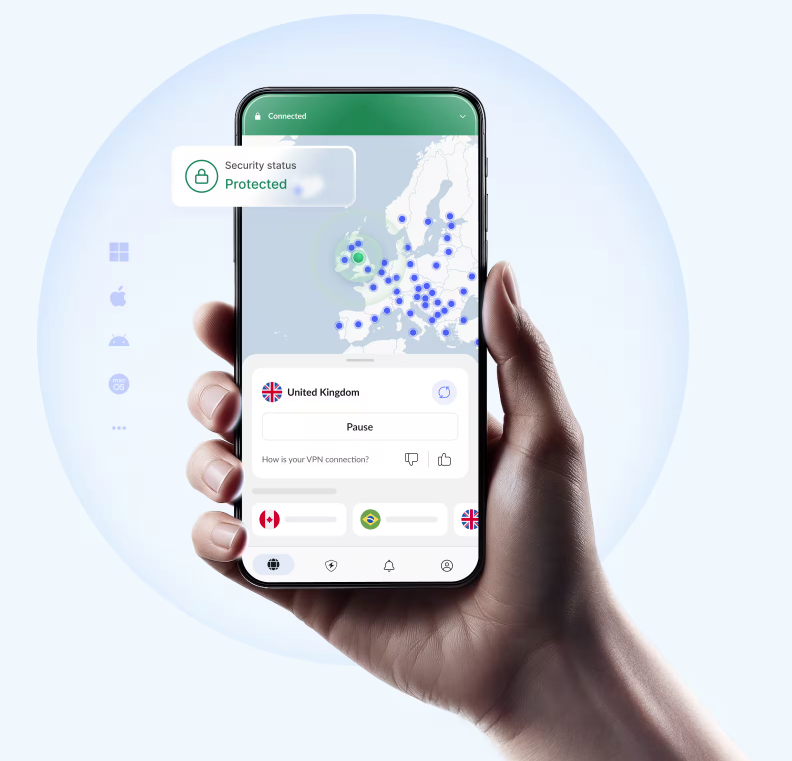
It does not replace good digital habits either, but what it does do is, it encrypts your traffic, reduces unnecessary exposure, it adds a layer of discretion and it removes your dependence on unknown networks.

In simple terms, using a reliable VPN service that creates a secure, encrypted, and private connection will reduce the amount of risk you are exposed to and help you work more safely online.
If you are a business owner, an online marketer, consultant, or any other professional who spends a meaningful part of your life online, this may be worth considering.
If you want to look at the tool I personally recommend, you can do so by clicking here:
>>> Browse with better online protection
(Full disclosure: This is an affiliate link. If you choose to use it, I may receive a commission at no extra cost to you.)
There is a subtle but important shift happening in the business world right now. Online security is quietly moving from something technical people worry about to something professionals take responsibility for.
This is happening not out of fear, but out of self-respect. Modern life is stressful enough as it is.
If you earn your living online and you value your overall quality of life, protecting the conditions that allow you to work reliably, calmly and consistently is no longer optional. It should be seen as an essential part of how you work.